
From Greek, “ekphrasis” denotes a description. Ekphrastic poetry commonly offers a vivid description of other works of art. One notable example of ekphrastic poetry is Romantic poet John Keats’ “Ode to a Grecian Urn”, where Keats narrates, contemplates and reimagines scenes painted on a Grecian urn to comment on larger themes of mortality, the passage of time, and the impermanence of youth in contrast with the eternal nature of art:

While the nature of my poems will be ekphrastic as in they will allude to the original films, I will go beyond mere description of the films to engage with some key words/ images/ themes that speak to me. These poems will serve as responses and re-imaginings of the original films. Readers may recognize some influences of philosophies and spiritualities like Buddhism, Taoism, Hinduism, Shamanism and Animism in my poems.
I encourage you to watch the original films before reading these poems. After that, read my poems to see what insights they might offer you, and how they enrich your understanding of the film, self and world. May you be moved into a new way of being.
Notes
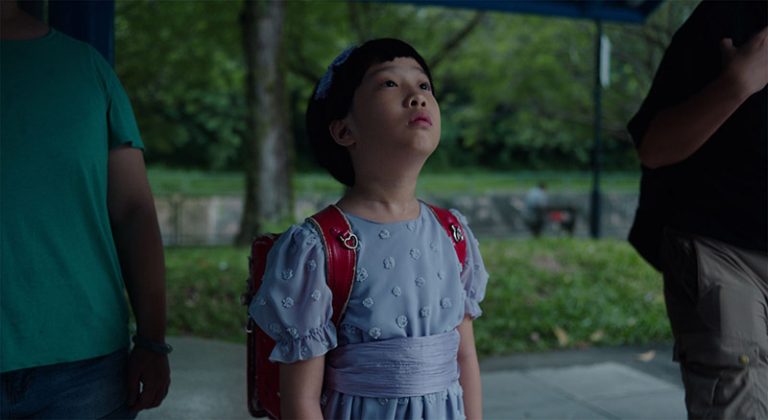
Ekphrasis 1: I rearranged the sequence of the film in my poetic response comprising four lyrics: Fetal, Mother, Queen and Lover, intentionally retitling Shadow to Fetal in my poem to foreground the idea of creation and birth. Each lyric is accompanied by a screenshot from the film encapsulating a key image referenced in my poems.
Ekphrasis 2: I write from the point of view of the forgotten island, repurposing some key words and phrases from the film while borrowing from the form of my poems “island city”, “We have forgotten” and “Hamsa”. The resultant poem offers readers an entry into confronting one’s fears, listening deeply to the voice of the spirits of the earth/ land/ forest/ trees/ rivers/ sea, and remembering “our shared sorrow”.
Ekphrasis 3: The motif of the jackfruit stood out to me, as well as the title “Beyond the Other Shore”, which alludes to the Sanskrit word and Buddhist term paramita, which means to cross over to the other shore (of non-suffering). I engage with the film’s theme of mortality by considering how we are not so different from the jackfruit—we grow, we ripen, we are harvested and eaten or we rot and return to the earth. Certain scenes and lines from the film have been adapted within the poem, and some lines in the poem are italicised to serve as commentary where the speaker addresses the readers directly.
Ekphrasis 4: The poem is a prose poem, incorporating aspects of the film to weave an authentic narrative about home, the body, change, loss, nature and the disruption of nature. The poem reflects on the speaker’s interior journey of loss (of mother, of home, of place, of health) through dream consciousness, and ends with a return home through fire, which is often used to signify change and transformation.

1 Fetal
Birth is violent, the womb torn open by frantic hands
Mother, where are you? Why am I all alone?
The darkness does not comfort me
and I am lying down with my back curved, my head bowed
my arms and legs bent and drawn up to my belly
Is this the beginning or the end of my suffering?
My hands search for recognition, but I have no eyes,
no nose, no mouth, no ears, no friend, only my hands…
A shadow tearing open

2 Mother
Your feet traverse this universe of eggs, where women’s bodies are tied to the eggs of their existence.
I awaken from my sleep, and find my feet bound by ropes to a massive egg. How did it appear overnight, and what could this mean? This was not ideal. I try to get out of bed and my egg prevents me from going too far. Maybe I can roll it around, but my egg is heavy and requires much effort. How will I leave my home with this egg in tow? Take the train, walk to school? My first instinct is to sever my cords, to restore my personal freedom.
I crawl to the kitchen dragging my egg. My hands reach for the knife, which I bring to the ropes at my feet. My hands linger there, and I swear the egg cries out before I even attempt anything. Why, this egg is sentient, and should I not look after it rather than cause it pain?
Egg, I am you and you are me, and I will tend to you with my utmost devotion and care.

3 Queen
Here you stand, decked out in crimson and scarlet,
proud and regal. Yet you are alone and unhappy,
cracking eggshells and strewing them on the ground like indecent conquest.
Who has taught you that beauty was cruel?
Where is your mother?
Where is your egg?
Release your ego, and return to the soft ways of the heart,
the runny yolk of compassion.
Why do you revel in the ruins of other women, trample on other eggs?

4 Lover
And though they look and stare you do not care
You are wild and free, like smoke, dancing, shaking, taking off your clothes
To those eyes, those eyes, those curious, peering eyes
Watching you. But you are watching them too
You are not putting on a show
They bring a needle close to your eye
You do not blink, instead, you open them wider and continue to shake
your body, shake the fear away, shake the violence that is inching towards you
They want to control your body, to stop it from moving, from dancing, from being free
They want to take away your joy
But you are Shakti and Shakti cannot be controlled
You are a woman and Woman is powerful when she remembers her wildness and magic
Remember who you are
Remember you are a woman with the capacity to love and to be free
Remember the joy in your heart and bones
Remember you have a body that desires what it desires
Remember the drumming of the earth
Remember you are wild

at the end of the day we are all jackfruits
spinning around in circles with our hands over our heads
tapdancing in our dreams
working resting eating shitting fucking vomiting in the toilet bowl
funeral pyres burning paper money
can you smell the ashes? the musky sweetness of overripe fruit?
we are heavy with the weight of our unlived lives
like a jackfruit lovingly kept aside, uneaten, whole
swelling in the cradle of our arms as we enter the riverbed
or fall on our knees to gu zheng music in the background of our story
broken body of fruit
the crickets are calling you home to the other shore
there you stand alone in a field or on a hillside
unseen by those walking before you against the setting sun
in one frame, the jackfruit of your life sinks
to the bottom of the river only to float back up again
in another, you are growing, ripening, rotting from the core
your daughter calls you but you hang up
why don’t you see the doctor?
don’t look back, the credits are rolling
you are now the jackfruit that has been washed ashore

A woman stands alone on a deserted highway, holding a kerosene lamp in her left hand. Is that you, mother? Or am I dreaming again? The plants you used to tend to have started to wither and die. They know my hands are not your hands, although I care for them with the devotion of my hands. In an old oil painting, a man kneels on the ground. My knees are starting to sing from the ache of old age, from the pain of your loss. My body refuses to listen. Mother, why did you take out all your clothes and walk in the rain with the scars still on your back? Why does the engine of the cement truck invade my dreams, leaving dust clouds in its wake? The crickets have come out tonight to celebrate the forest, they have come to sing. The moon is full in the night sky and in my dream, I hold your hand with both hands, cleaning each one with a wet cloth. Tonight, there is thunder and the smell of rain. The forest appears to me at night, whole and undisturbed as in a dream, unlike the fragments of the day. The forest is showing me her scars, asking that I tend to her. Koel calls out across the newly constructed highway to its absent mate. I am standing alone in the forest, bonfire burning at the forest edge. The fire is a beacon, lighting my way home.
About the Author
 Photo credit: Ethan Leong
Esther Vincent is the editor-in-chief and founder of The Tiger Moth Review, an eco journal of art and literature based in Singapore. She is the author of womb song and Red Earth, and co-editor of Here was Once the Sea: An Anthology of Southeast Asian Ecowriting, Making Kin: Ecofeminist Essays from Singapore, Poetry Moves and Little Things. Besides teaching and writing, Esther is an Usui Reiki Master and ANFT Forest Therapy Guide-in-training whose practice involves relating to the more-than-human world in an embodied, heart-centred way.
The opinions expressed in this article are the author’s own and do not reflect the view of the Asian Film Archive.


