

I spent a week just before National Day gamboling in the hills of Cameron Highlands, a refugee from the ceaseless summer of our equatorial home. This is an absurd township, I thought to myself, while walking down its streets, a task one can complete in less than an hour. Its buildings were almost uniformly dressed in an unconvincing, drab mock-Tudor garb. Every other shop purported to sell the best scones and jam. (Even while studying in the UK, I had not seen such rampant proliferation of these confections.) The local deity seemed to be the strawberry, an icon and mascot one glimpses absolutely everywhere: fridge magnets, postcards, cushions, soft toys. I found myself unable to resist an alpaca plushie (with a strawberry sewn to its neck, no less, like some sort of Mad Hatter tracheostomy). The playlist of the one bar in town contained nothing from this millennium. I was in a sort of hastily photocopied Merry England, transposed to the 90s, refracted through a shattered looking glass.

This proved a strangely apt vantage point to contemplate this year’s selection of Singapore Shorts. The past persists visibly in the Highlands, a syrupy residue of colonial settlement. The British had envisaged it as a hill station and resort, transmuting their sickness for home into a rural mountain idyll. Improbably, their successors spared it from the rigours of decolonisation, and happily slapped on more cream and jam. Cameron Highlands also had a small but surprisingly pivotal part in the formation of two improbable polities: Malaysia and Singapore. Lee Kuan Yew used to bring his family here – or another hill station, Fraser Hill – for holidays at least once a year, making ample use of its golf courses. On 11 Aug 1961, amid the fractious and frenetic campaign for merger with Malaya, Lee Kuan Yew escaped here with his family, from what he described as the “political hothouse of Singapore”. Over a fortnight, between rounds of golf, he drafted eight of what would become a series of twelve radio talks on merger. Through these iconic addresses, Lee made the case for merger directly to the people of Singapore on the air waves, convincing them to become part of Malaysia.
On 3 Aug 1965, from Cluny Lodge, the same bungalow that Lee retreated to almost exactly four years before, Lee received a call from Goh Keng Swee, confirming that things were on track for the seismic cleaving of Singapore from Malaysia. They spoke in Chinese – neither’s best suit – to obfuscate the phone operators. A few days later, on 6 Aug, Lee would descend to Kuala Lumpur, to supervise and approve the documents for the Separation. Then on 8 Aug, he would fly back to Singapore, to obtain signatures from the rest of the Cabinet. The rest is history, we like to say. Yet the past is never truly past: as the revelations of the recently reopened Albatross files demonstrate, history is a verdant field for contestation and renegotiation. Time is still raw and unbaked in recently postcolonial Southeast Asia. Phantasms from personal, familial and national pasts, reemerge from the fog and haunt this year’s selection of Singapore Shorts.
 Image still from bendungan (2025, Jee Chan)
The persistence of the past and its palpable stickiness is felt in the very first short, Jee Chan’s bendungan, where three disparate stories situated against the backdrop of the colonial project of the Dutch East Indies stream together to fill a melancholy pool of reflection. A Dutch lady chases the shades of her childhood memories, all the way back to the Maluku islands, where her family used to reside, arriving at a beach where her father used to live. She speaks of tearing up at the sight of the beach, vividly recalling her father’s voice, a poignant memory complicated by the spectre of colonial extraction and hierarchy. Yet oceans do not guard their boundaries as jealously as nation-states, and her grief, like all other griefs, gradually flows into a single sea.
Families are their own particular jagged terrain, nesting sealed-off caverns and burrows, where ancient secrets and varieties of grievance lurk, like primordial pathogens frozen in ice, awaiting the thaw. When they resurface, as they do in Hoe Jian Wei’s fish, in the form of a grandfather returning from the dead to possess – and revive – his grandson, the unsettled potentiality of the past expresses itself as a disruptive force that threatens to destabilise the family unit. Some of us, especially those who’ve been through a bruising Chinese New Year season of inquisition and dysfunction, have long suspected such sinister and atavistic forces lay at the radioactive heart of the family. These are gloriously unleashed in Zachariah Wee’s riotously off-the-wall depiction of a reunion dinner, Dinner with the Zhangs, pushing conspicuous consumption and weaponised social aspiration to its grotesque, yet oddly intuitive, extreme. It is a delicious realisation of a quote of Don DeLillo’s: the family is strongest where objective reality is most likely to be misinterpreted.
As a schoolboy in Singapore, we used to purchase these brown jotter exercise books from the co-op. At the back of the books were listed five shared values of Singapore, with one being – if memory serves me right – “Family as the basic unit of society”. This building block now faces an alarming existential crisis, with Singapore’s fertility rate plummeting to a historic low in 2025. The Government even stood up a ‘Marriage and Parenthood Reset Workgroup’ to wrestle with this wicked problem. Yet, perhaps, in this moment nests an invitation to radically and generously reimagine the contours and shape of the family.
 Image still from Two Travelling Aunties (2025, Christine Seow)
Several shorts in this year’s selection take up this invitation. In Jen Nee Lim’s Buah, as the confines of patriarchy and motherhood close in on Siti, she befriends a mysterious, freewheeling female bus driver who seems to point a way out. The shocking, graphic denouément may come as a nasty surprise to some; yet the harnessing of horror to jolt and interrogate the strictures of social order follows a long tradition in the genre, where moments of terror and disgust liberate the deeply sublimated desires of the repressed. This film finds a gentler, but no less effective, counterpoint and parallel in Christine Seow’s Two Travelling Aunties, a deeply affecting documentary of Norah and Susie, two lesbian lovers who found their home on the road – and in each other. On one level, what links these two films is the road and the motor vehicle, encapsulating the promise of queer liberation and escape. But Two Travelling Aunties complicates and enriches this narrative, as the two aunties are constantly reminded of the threads that tie them back to the loved ones waiting for them: an ageing mother Susie’s suddenly reminded of, and feels guilt leaving behind; a beloved niece who appears via a video call. Singapore, then, isn’t a prison-house they’re fleeing, but a home they wish made more space for them. (One of them happily wears an I<3SG t-shirt.) Towards the end, the aunties stage a photoshoot on an idyllic beach, unfurling a Singapore flag in the wind, a scene that could easily have fit into a National Day montage – sans the lingering kiss between them.
 Image still from Ibu (2025, Jessi Goh)
Like so many queer people, in their own trailblazing, quietly defiant way, Susie and Norah have forged their own hard-won families. Nowhere is this more gorgeously demonstrated than in Jessi Goh’s Ibu, which celebrates the figure of the legendary pioneering drag queen Kak Nina Boo, who is a motherly figure to Bhuvan Daniel, a trans man, and a whole community of younger queer people. It’s a tale of Kak Nina’s incredible resilience: she recounts the hardships she had to endure, as an early transwoman trying to make her way in the cutthroat world of cabaret, including being rounded up by the police. It is not a facile joke to say that Kak Nina seems to be constantly in transition: far from being a sagely elder resting on her laurels, Ibu chronicles her journey in another scene – that of the ballroom, where she emerges triumphant (“tens across the board!”), and gratefully thanks a younger generation of queers for accepting her into this new scene. In that sense, Kak Nina’s story also becomes an apt reflection of Singapore, a nation whose defining condition is perpetual transformation – something we are conditioned to believe is a necessity, given our smallness and vulnerability. In the films seaward by Saksham Mehrotra and Hourglass by Eric Teo, we are starkly reminded of our sand-hungry island, whose borders are constantly being redrawn – and the drastic impact of this restless reinvention.
Does reinvention have its limits? Singapore’s now at an awkward 61, near retirement age, with a dramatically ageing population, and it is striking how ageing surfaces as a theme across some of this year’s shorts. Kak Nina’s nearly 60 this year, despite looking unremittingly fabulous. The two travelling aunties converse while swinging on hammocks, and one of them confesses their greatest fear is losing their memory. We all have an expiry date, one says. Then, in another moment, another says you make me want to live longer. In making up for lost time, and leading their own intrepid expedition, the aunties have made something new of life. Meanwhile Maryanne, the chainsmoking queenpin of a tissue-peddling racket in the endlessly entertaining The 4PLY Clandestine System by Natalie Sin, is another example of our elders living large. Her cartel of cowed, ragtag tissue peddlers reaches deep into the heartlands, a shiny green smiley face sticker on their personal mobility devices in lieu of gang tattoos. Behind the off-kilter machinations of this mockumentary conspiracy, however, lie shadows of serious questions. If Maryanne takes care of her numerous underlings, who takes care of Maryanne? The seeming farce of a stuffed doll as a stand-in daughter points to deeper anxieties at the heart of silver Singapore.
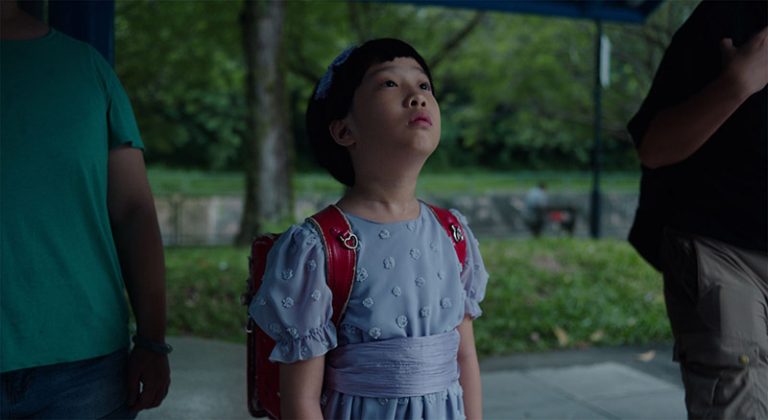
These anxieties reach a fever pitch in three films which extend the conspiratorial and paranoid, a mood which is unusually apposite in the information-dense high Modernist state of Singapore. The unbuckling rationality of the nation-state seems to invite the swift proliferation of misinformation and conspiracy, seeming to necessitate state discipline in the form of extensive information laws. (The other way this is manifested is in our love of ghost stories – and our unquenched desire for these phantoms to disrupt and remake our lives, as witnessed in some of the films discussed earlier, such as Buah and fish.) Living in Singapore through COVID, for example, was akin to swimming through a fibrous sea of rumour. Alistair Quak’s Seismic Brain Implosion unnervingly explores the limit of conspiratorial noir through maximising the eerie potentiality of the HDB apartment and its confines. It’s a welcome flash of visceral body horror. An aura of menace, intensified with apocalyptic dread, is harnessed in Grace Song’s Hour of the Flower, which combines the ideal protagonist of horror – the child – with the ecohorror enigma of the jungle. I found myself particularly drawn to Jake Low’s Manhole, which stands out for me with its fabulist class commentary, once a mainstay of Singapore cinema. You find a man inexplicably lodged in your house’s drain just below the drain cover. Do you hack your floors to rescue him or do what the plumber suggests, and plunge three times, flushing him away – out of sight and out of mind? In this country of near-perfect sanitation, obsessed with convenience and quiet, I fear what my compatriots’ answer will be.
 Image still from Durian, Durian (2025, Nelson Yeo)
We end the programme with another iconic fruit. Two strangers lie under a durian tree, wishing to be maimed (and hopefully, implausibly, murdered) by a falling durian. Nelson Yeo is a master of winsome ridiculousness (or “moleitau”, in the parlance of Hong Kong film), here energetically compressed by the short. One stranger justifies his desire for death by recounting how his wife has left him for another man. The other supplicant says she is happily married to a loving husband, but has always wanted to die. The two end up dancing at the beach in a karaoke-style music video, holding the spiky fruit between their hands, singing durian, durian in Mandarin. The Mandarin word for durian, liulian, is a homophone for longing. I am reminded of the closing scene of Tsai Ming-Liang’s Goodbye, Dragon Inn. The crippled ticket attendant hobbles away from the shuttered cinema in the rain, as the Chinese singer Yao Lee croons another song titled Liu Lian, which describes longing (or wait, is it the fruit?) as half bitter-sour, half honey-sweet.
Singapore’s past our saccharine strawberry days. Connoisseurs of the durian savour the dance between the initial hit of sweet custard and the lingering bitterness, reminiscent of cognac. This year’s shorts embrace and embody the essence of the durian, releasing the pungent and the lurid from Singapore’s tightly wound core. An improbable nation deserves a peculiar fruit. Be like the durian! I say, in all its prickly, irreducible glory.

About the Writer
 Daryl Lim Wei Jie is a poet, literary curator and art critic from Singapore. His latest collection of poetry is Mistranslations from a Future Vernacular. He has conceptualised and co-edited several literary anthologies, the latest being Free to Play: A Video Games Anthology. In 2023, he was awarded the Young Artist Award, Singapore’s highest honour for art practitioners under 35.


