
In his essay, “The Road People”, poet Gwee Li Sui argues that the road may be the most appropriate metaphor for the Singaporean condition:
“The road—more than the skyscraper or the economy—is the quintessential image of urban processes. The road is not just the city’s life-giver and shaper, its circulatory system, but also a paradoxically unliveable space, a desert stretch.”¹
Singapore is a restless nation that has embraced speed, efficiency, and progress as its core values. Despite the scarcity of land, a significant proportion of our land surface is given over to motorways, with new roads paved every year, privileging the use of automobiles over other forms of transportation. Representing affluence, convenience and air-conditioned comfort, a car is a status symbol in this country, a sign of having made it. The bitter irony, of course, is that there is no destination. We are perpetually on the move, striving towards a horizon we can never reach.
Refuge Island, a programme of short films from Singapore, takes mobility as its theme, exploring how ceaseless movement came to be a prerequisite for survival and social advancement, and where one might seek respite from the merciless demands of the road. The programme title proposes an answer to the latter question, with recourse to a commonplace architectural feature: the refuge island, a section of pavement built in the middle of busy streets that lack marked crosswalks or traffic lights. The elevated concrete block provides pedestrians with a safe place to pause and survey the situation, to wait for the traffic to ebb.
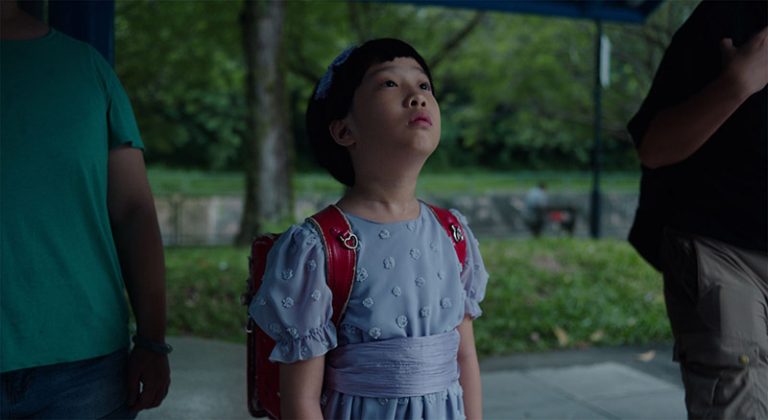
Refuge Island opens with Nelson Yeo’s Myths (2016), which follows two children as they discover a vintage headset and watch an old film reel in an abandoned lot. This simple plot belies a more complex question, of how our historical legacy of itinerancy bears on a younger generation of urbanites.
Myths nods to our roots and rootlessness, with reference to two earlier works from Singapore. The first is Edwin Thumboo’s Ulysses by the Merlion, playing through the salvaged headset. Written from the perspective of the mythic hero, Ulysses, this iconic poem imagines him encountering the Merlion, a strange hybrid of fish and lion. To the worldly-wise adventurer, the chimeric mascot embodies Singapore’s incoherent identity, a crude synthesis of ancestral cultures and modern influences.
The second intertextual reference is Tunang Pak Dukun (1960), a Cathay-Keris production from the golden years of studio film in Singapore. In this film within a film, a musical number shows villagers returning to their kampong while singing Pulang Merantau, in anticipation of their homecoming. Invoking the practice of merantau, a centuries-old ritual of migration and a rite of passage common throughout the Malay Archipelago, Myths posits a historical continuity from the nomadic patterns of the past to our globalised present.²
 Image still from Myths (2016, Nelson Yeo)
Starting with this film frames the programme around the figure of the sojourner: the Homeric hero; the wanderer of the Nusantara; the curious children transported to a bygone era. The title, Myths, reminds us that there are dominant narratives we have subscribed to, or spun for ourselves, as an immigrant society negotiating the tension between perambulation and staying put, change and constancy.
While Yeo offers a slightly romanticised, nostalgic vision of wandering, Berita Singapura: Road Safety Measures (1967) plunges us into the rhythms of post-independence Singapore, where mobility is strictly regulated. The state-produced commercial is one in a series of multilingual newsreels that aired weekly during the first decade of television in Singapore, and the heavy-handed messaging illustrates the making of a road people.
We see examples of deviant behaviour like jaywalking, speeding and reckless driving, as well as the wreckage of cars, with shattered glass and crumpled metal visualising the tragic consequences of flouting traffic rules. A commentator recites statistics about the thousands of deaths caused by road accidents each year. Hyper-vigilance is encouraged, and the individual is advised to take responsibility for themselves, to manage the risks of the road.
 Image still from Berita Singapura: Road Safety Measures (1967)
Against the backdrop of a rapidly modernising city, the unruly masses need coordination and containment. The physical topography moulds its citizens’ psychic landscape, as urban space is coded into zones of relative safety, with pedestrians keeping to designated pavements and overhead bridges. Citizens are schooled in road etiquette, through the iconography of stop signs, speed limits, and traffic lights. The road is not just a metaphor, but a mechanism for mass conditioning,
Decades of didactic control predictably produce a pliant, if dispassionate, population. Carol Ho and Teo Mei-Ann’s Not Here (2008) sets us in contemporary Singapore, where white-collar workers eke out their living in an environment geared toward profit and productivity. Two professionals take in the panoramic view from their office, but it offers no visual delight, only the sight of cranes, roads and buildings stretching as far as the eye can see. Confronted by this dull prospect, they start to feel the faint stirrings of lust.
 Image still from Not Here (Carol Ho and Teo Mei-Ann, 2008)
But their attempts to find a spot to consummate their tentative desires are thwarted at every turn. An office bathroom, the backseat of a car, a HDB stairwell, and even a hotel room, prove inadequate. Each space is either too public, too cramped, or too trite—even when they can secure a space for themselves, they hear another couple in the next room, and suddenly feel like a stereotype, engaging in an illicit workplace affair. In these urban settings, the two are self-conscious, their bodies bumping awkwardly against each other. Human connection is strained, and verbal communication is muted. There is little dialogue, except for a single refrain, “not here”, muttered each time the characters fail to find a satisfactory place for sex. The city is no place for erotic pleasure.
Only when they go off road and enter a forest clearing do they discover a sense of privacy, a reprieve from scrutiny and surveillance. The lush beauty and sensuality of nature, with the gentle hum of insects, offers a peaceful, secluded site for intimacy. As their inhibitions and internalised shame fall away, the man whispers, “here”. The camera, trained intently on the characters throughout the film, finally pulls away, leaving the pair to their lovemaking.
 Image still from Not Here (2008, Carol Ho and Teo Mei-Ann)
These characters do not fully transcend the trope of the Singaporean professional desperate to escape the tedium of corporate culture. The retreat to nature and the release of sex might displace our energies or distract us from the monotony of work but cannot free us from the demands of capitalism. Other liberatory possibilities are intimated, in the freedom of motion. As they coast down the streets on a motorcycle, the camera lingers on the woman’s hands clutching his waist, his own fingers wrapped around the handlebars. These moments conjure the thrill of the ride, recalling similar scenes in Eating Air (Kelvin Tong and Jasmine Ng, 1999) and Fallen Angels (Wong Kar Wai, 1995), where lovers seek automotive exhilaration as an antidote to urban alienation. The rush of the open road is fleeting, but enough to make them feel alive.
What does movement mean to us, and how are its meanings mobilised in service of different agendas? In Berita Singapura: Nation on the Move (1965), movement is synonymous with survival and success. The newsreel shows the cityscape taking shape, as Singapore is terraformed and sculpted into a model of efficient urban living. Construction proceeds apace, with plans for more public flats and university buildings to house and educate the population. Nicoll Highway is widened to relieve traffic congestion, and Jurong Oil Refinery is projected to boost our economy. Even our landmass poses no limit, with reclamation works underway to extend our terrestrial boundaries. From the earliest days of independence, an ideology of pragmatism is cemented in our infrastructure.
 Image still from Berita Singapura: Nation on the Move (1965)
In a self-congratulatory voiceover, the commentator extolls the nation’s aspirations for progress and the collective commitment to securing our future. With the benefit of retrospect, we might temper the heady optimism of the developmental state. We know that the pursuit of incessant growth does not lead only to gains; over time, social and environmental deficits accrue.
A particularly ironic effect of Singapore’s streamlined transport networks is the need for dedicated physical activity, with a concomitant demand for expensive fitness classes and gym memberships. Tan Pin Pin’s documentary walk walk (2023) considers the humbler act of walking, and the range of reflections it inspires.
 Image still from walk walk (2023, Tan Pin Pin)
Through her interviews, Tan chronicles their motivations for taking walks. For a group of middle-aged women, their social walking club is a source of mutual support. For a visual practitioner, traversing the city by foot is a more solitary recreation, a way to find mental clarity and to notice the peculiarities of her neighbourhood. For artist Amanda Heng, walking is a gesture of resistance. Her public performances, Walking the Stool (1999–) and Let’s Walk (1997–) turn the streets into a stage, challenging social norms and protesting regressive societal attitudes of women.
All the interviewees are women, and a common thread across their responses is the urge to carve out space for themselves. Movement takes on a distinct valence—it is not the interminable march forward, but an intentional mode of being present, cultivating appreciation for the world around us, and exercising bodily autonomy. At one point, Tan asks, “Where are you going?” and Heng replies, “Going for a walk.” This exchange upsets the teleological assumption that we walk to go places. We walk for the joy of it, a sentiment captured in the charming phrase, “walk walk”. Alluding to local expressions like kia kia (Teochew) or jalan-jalan (Malay), it connotes a leisurely stroll.
 Image still from Berita Singapura: Keeping Fit (1967)
In contrast, Berita Singapura: Keeping Fit (1967) traffics in the overtly moralistic discourse of healthy living. The newsreel features bodybuilding, martial arts, and military drills as examples of the training regimes people should adopt to keep fit. Bodies are instrumentalised and those who fail to bulk up or slim down are “going to be left behind”, the commentator warns, conflating physical movement with social mobility. This bleak vision of physical training has more to do with discipline and conformity than the personal journey, inducting us into the cult of self-optimisation.
The rules of the road may already be written, but navigating those rules creatively can be a practice of self-expression within an oppressive environment. Ryan Benjamin Lee’s experimental animation, Axis (2022) takes inspiration from late artist Chng Seok Tin, in particular, her drypoint prints, Social Climbers (1992) and Gold Rush (1993), which depict human figures locked in a brutal, unforgiving race for wealth and status; and Game of Chess (1999–2001), an installation that depicts life as a series of calculated, strategic moves.³
 Image still from Axis (2022, Ryan Benjamin Lee)
Borrowing from Chng’s monochromatic palette, Axis starts with a series of black and white rectangular shapes in gridded patterns. These motifs could indicate either traffic junctions and crossings, if we are looking from above, at an aerial view of the city; or high-rise buildings, if we are looking up from below, at street level. The horizontal and vertical planes converge and come apart, as the axis of vision tilts and the film plays with perspective.
Colour seeps into the world with the introduction of a human-like figure. The monochrome structures mutate, morphing from a chessboard into a synth pad on which the figure frolics. Piano keys sound as it hops from square to square, releasing tendrils of vibrant colour as it interacts with the grid. However rigid the existing structures, it is possible to discover whimsy and dance within the lines.
Gladys Ng’s Every Floor Looks the Same (2022) is more circumspect about the potential for originality, in a country where passion is routinely stifled. The synopsis tells us that Osmanthüs is languishing—a term popularised by pandemic lockdowns, denoting a state of joyless, aimless stagnation. Osmanthüs certainly fits the description. As she lazes at the playground, attends music lessons, and takes the bus, she remains detached from everything. She quietly observes the city, but the homogenous cityscape rouses little excitement in our young protagonist.
 Image still from Every Floor Looks the Same (2022, Gladys Ng)
Around her, empty husks of buildings mirror the hollowness of life. The drone of construction, tree pruning and estate maintenance never lets up, constituting the musical signature of a city and its discontents. This incessant mechanical soundscape is jarringly interrupted by a child’s protracted scream at an amusement park. Whether out of terror or glee, it is a rare display of emotion. Another is a hand drawn poster for a missing bird. Amidst flyers advertising PSLE tuition and grassroots events, the childish sketch and heartfelt appeal stands out. The missing pet eventually finds its way back, in the form of a stuffed toy that Osmanthüs tapes to the noticeboard. But the actual bird is never found, nor even glimpsed.
The film might seem to end on a cynical note, confirming an inauthentic and soulless existence, if all we are left with is a semblance of the real. But I imagine that the living bird has embarked on its own merantau, departing on a line of flight and perhaps finding a home in the wilderness. And there may indeed be a way out, as recurring motifs of alluring greenery and open sky, framed through stairwells and windows, suggest openings to an elsewhere.
 Image still from Every Floor Looks the Same (2022, Gladys Ng)
Refuge Island alternates between archival material and contemporary short films, generating antithesis between independent media and state propaganda, and an anachronistic whiplash that subverts the linear logic of the road. This sequencing stages the dynamic contest of ideas that characterises the conceptual economy of the short film in Singapore.
A medium of brevity, the short film is eminently portable.⁴ Like TikTok reels that feed off our cooked attention spans, state commercials slip into the cracks between regular programming, reaching a broad viewership. But the short film is as much a tool of corporate and government control as a means of personal expression and artistic experimentation, of charting alternative perspectives. Independent shorts function as refuge islands, too. Often anthologised, they form archipelagic configurations with other films. The short moving image works included in this programme find affinities with multiple forms of arts, including poetry, printmaking, and performance. Migrating across galleries, cinemas, and bus interchanges, and circulating online, they are irrepressibly mobile.
Paradoxically, an actual refuge island is a space of paralysis, offering momentary respite but not meaningful rest. Perched on a median, stranded between an onslaught of cars from both directions, I usually feel tense, exposed and vulnerable. There is clearly no exit from the punitive expressway that is Singapore. Rather, the safety island is designed and sanctioned for pedestrian use, so whatever refuge can be sought exists on the terms of the central urban planner, part of an architecture of control. Yet, that sliver of concrete, just wide enough to accommodate an individual, affords some breathing room amidst the relentless traffic—a refuge from the road that is precarious, and precious, nonetheless.
Footnotes
About the Writer
 Tracey Toh is an arts writer and researcher who practises creative criticism in response to film, literature and performance.
The opinions expressed in this article are the author’s own and do not reflect the view of the Asian Film Archive.


