
Among the films screening as part of the ‘Reciprocal 2026’ collaborative programme is Dancing Othello (2002), a rarely screened short film by the Indian filmmaker, author and lecturer Ashish Avikunthak. The film follows an Indian performer (Arjun Raina) who recites numerous passages from Shakespeare’s Othello while dressed for Kathakali: a highly stylised dance-drama tradition originating from the Kerala region in which gesture and choreography take precedence over spoken dialogue. The juxtaposition of historic Indian and English artforms intuitively speaks to modern India’s ongoing postcolonial idiosyncrasies and tensions in ways that I, as a British film scholar, am perhaps not best placed to fully articulate. Instead, I want to highlight a particularly striking moment midway through the film where an exasperated Raina cuts one of his recitals short. Not understanding why Avikunthak wants to keep filming his performances, Raina, hands raised, looks past the camera and repeatedly pleads with the director: ‘What is the social message of this film?’ Whether this exchange is genuine or staged is unclear. Either way, Raina’s question about the ultimate purpose of the film is one that resonates across the entire ‘Reciprocal 2026’ programme, whose diverse selection of shorts and features repeatedly invites us to ask what independent cinema is and what it can mean.
 Image still from Dancing Othello (2002, Ashish Avikunthak)
‘Reciprocal 2026’ sees its home institution, the Asian Film Archive (AFA) based in Singapore, collaborate with the Fukuoka City Public Library Film Archive (FCPLFA) of Japan. Like AFA, FCPLFA’s mission is to preserve cinema from across Asia in addition to the work of local filmmakers. Opened in 1996, FCPLFA holds over 3,300 films from around 30 Asian countries, while also supporting local film culture through its involvement with festivals, including the former Focus on Asia Fukuoka International Film Festival, and citizen/amateur filmmaking initiatives, such as those organised by the Fukuoka Film Association (Fukuoka Eizō Kyokai). The archive also runs its own Ciné-Là cinema that offers various film programmes throughout the year. FCPLFA’s contribution to ‘Reciprocal 2026’ is drawn entirely from its Japanese film collection, including films by Fukuoka natives Takashi Itō and Gakuryū Ishii (aka Sōgo Ishii), who both played instrumental roles in reshaping Japanese moving image culture at the turn of the 1980s (and have continued to reinvent themselves since), as well as films by contemporary female auteurs Kaori Oda and Natsuka Kusano. It also includes a special programme dedicated to Tarō Nakayama (1917-1992), a prolific and pioneering amateur filmmaker from Fukuoka. This year’s ‘Reciprocal’ marks the first time any of Nakayama’s films have been screened outside Japan in almost 65 years. It is also the first time any have been screened with English subtitles thanks to the support of the Nagase Film Foundation.
 In Conversation: From Archive to Screen – Presenting and Preserving Independent Cinema, held on 13 June 2026. The session featured filmmakers Daniel Hui, Kaori Oda and Takashi Ito, together with representatives from the Fukuoka City Public Library Film Archive (FCPLFA) and the Asian Film Archive (AFA) and was moderated by Mark Player.
Conversely, AFA’s contribution to ‘Reciprocal 2026’ spans multiple Asian countries, including Singapore, Malaysia, the Philippines and India, and brings together rarely screened works by filmmakers such as Daniel Hui, Tan Chui Mui, Jet Leyco, and the previously mentioned Ashish Avikunthak, whose debut feature Shadows Formless (Nirakar Chhaya, 2007) also appears in the programme. In response to FCPLFA’s spotlight on Tarō Nakayama, AFA offers an amateur film showcase of its own: five surviving short films by Rajendra Gour (1940-2023), an Indian national who lived most of his life in Singapore. Together, the two archives present 28 shorts and features spanning over 70 years of different kinds of what can be broadly described as independent filmmaking from across East, Southeast and South Asia.
Independent cinema is often defined in economic terms, referring to films funded and produced outside of dominant industrial models of film production. Such films are often assumed to operate with fewer resources, a limitation that can shape both how they are made and how they are discussed. For example, in the weeks leading up to ‘Reciprocal 2026’, the international film press was alight with enthusiastic coverage of Obsession (2025), a low-budget American horror feature directed by YouTuber-filmmaker Curry Barker on a reported budget of around US$750,000. Much was made about the fact that it was an ‘independent film’ that went on to become one of the most profitable releases of the year. This feat was possible after its distribution rights were purchased for around US$15 million, leading to a global theatrical release window and extensive promotion, and thus complicating its status as an independent film. It also represents a very different set of circumstances from those Asian independent films included in ‘Reciprocal 2026’, which exist within different economies of scale, labour-industry relations, distribution ecologies, and sociopolitical circumstances.
That is not to say, however, that independent filmmaking from this part of the world does or should operate without any institutional support. Included in this year’s programme, for example, is Malaysian filmmaker Tan Chui Mui’s second feature, Year Without a Summer (Berkelana, 2011), which received support from International Film Festival Rotterdam’s prestigious Hubert Bals Fund. Furthermore, almost every film in the programme has relied—or continues to rely—upon the work of film archives, whether AFA, FCPLFA or other institutions, reminding us that independence is often sustained through preservation as much as production. Indeed, ‘Reciprocal 2026’ ultimately points towards a much broader understanding of independence, suggesting that the ‘independence’ of independent cinema is shaped not only by economics, but also by form, voice and the diverse circumstances under which films are made. The programme thus reveals multiple meanings of independence, be it through formal experimentation, the enduring commitment of amateur filmmakers, the transmission of memory across generations, or deeply personal forms of artistic expression.
One way in which ‘Reciprocal 2026’ broadens our understanding of independent cinema is through its embrace of films that resist easy categorisation, moving between fiction, documentary, experimental and animated modes with ease. Thus, their independence lies not simply in how they are financed, but in the freedom to ask what cinema can be. Takashi Itō, one of the veteran filmmakers of the programme, illustrates this particularly well. His breakthrough short, Spacy (1981), made while he was still a student at Kyushu Institute of Design, has become a landmark of Japanese experimental cinema. In the film, a disused university gymnasium becomes a site in which space and image converge, achieved by rephotographing hundreds of sequential still images that also appear within the film as blown-up photos placed on carefully positioned easels. This produces a recursive and dizzying mise-en-abyme effect as the camera hurtles towards and passes through one image after another. This was paired with Itō’s most recent, almost feature-length film, Distant Voices (Tōi koe, 2024). Aside from its opening sequence, which recalls the stop-motion dynamism of Itō’s earlier works, Distant Voices moves in the opposite direction. Itō’s trademark accumulation of re-animated images gives way to long, contemplative takes in which two young women photographers, one dressed in black and the other in white, separately wander through the same desolate urban and semi-rural locations as if living shadows of one another. Narrative gives way to atmosphere, rhythm and repetition, inviting viewers to inhabit and dwell upon the film’s spaces and their meanings rather than simply move through them. Together, Spacy and Distant Voices also demonstrate that formal experimentation is not merely a youthful provocation, but a lifelong creative practice spanning nearly 50 years.
 Image stills from Spacy (1981) and Distant Voices (2024), both by Takashi Ito
Elsewhere in the programme, experimentation extends beyond questions of space and perception to the materiality of cinema itself, as can be seen in the short film The Inescapable Desire of Roots (Gēn yù, 2024) by the Singaporean artist-filmmaker duo Mark Chua and Lam Li Shuen. The film shows a man being consumed by anguish and ecstasy as hair suddenly grows all over his body, whereas the film itself layers projections made from 16mm and Super 8 film loops incorporating the filmmakers’ own hair, creating a visceral and provocative meditation on corporeality and desire. Here, analogue film is more than a recording medium: it becomes a physical substance capable of carrying traces of the filmmakers themselves.

Meanwhile, Gakuryū Ishii’s sprawling Self-Revolutionary Cinematic Struggle (Jibun kakumei eiga tōsō, 2024) approaches the formal freedoms of independent filmmaking from a more metareferential direction. Ishii famously burst onto the Japanese filmmaking scene with a string of incendiary student-turned-professional works in the late 1970s and early 1980s, forging a new path for young aspiring filmmakers to enter Japan’s film industry after years of stagnation. Four decades later, Self-Revolutionary Cinematic Struggle comes full circle. The film is part self-portrait and part creative sandbox for the venerable filmmaker, who has since become a film professor at the Kobe Institute of Technology—the former student filmmaker has now become a teacher filmmaker. In the film, Ishii (playing himself) mysteriously disappears, leaving behind a manifesto for a ‘self-revolutionary movie struggle work’ that his real-life film students attempt to realise, leading to various vignettes that incorporate everything from large-scale brawls to musical numbers. In doing so, the work collapses distinctions between teacher and student, filmmaker and subject, rehearsal and finished film. Here, independent cinema assumes the form of an ongoing collaborative practice in which ideas, methods and creative impulses are passed from one generation to the next via an exuberant collage of genre exercises and stylistic experiments. Conversely, Natsuka Kusano’s similarly lengthy Domains (Ōkoku (Aruiwa sono-ka ni tsuite), 2019) also blurs the boundaries between performance and lived experience, but does so with remarkable restraint, constructing its narrative almost entirely through repeated table reads with the actors that gradually dissolve the distinction between rehearsal and reality.
 Image still from Domains (2019, Natsuka Kusano)
If one meaning of independent cinema lies in its capacity to experiment with different forms, another meaning emerges through its relationship with memory and preservation. Many films in this year’s ‘Reciprocal’ engage with lives, places and traditions that might otherwise slip beyond living memory if not for the interests and actions of independent filmmakers. This is especially evident in the two amateur filmmaker strands within the programme, featuring Tarō Nakayama and Rajendra Gour, where films are made for love over most other considerations. Tarō Nakayama made his living as a physician, yet spent decades producing an impressive body of short 8mm films in and around Fukuoka throughout the 1950s and 60s. This included documentaries dedicated to local crafts such as Hakata Dolls (Hakata ningyō, 1954) and Kurume Kasuri (Kurume gasuri, 1954). The former details the process of locally-renowned master doll-maker Yoichi Kojima while also capturing Fukuoka’s post-war redevelopment; whereas the latter follows the process of making Kurume kasuri, a locally-famous cotton textile from nearby Kurume city whose methods of dyeing, binding and weaving date back hundreds of years. Both films thus show how long-running traditions have endured and adapted during Japan’s post-war modernisation and have become significant time capsules of local Kyushu history.
 Image stills from 煙の見える海 (The Sea Where Smoke Can Be Seen, 1953), 仔熊物語 (Little Bear Story, 1956), 秋晴れの日に (On a Clear Autumn Day, 1955) and 旅役者 (The Travelling Actors, 1958) all by Tarō Nakayama
But Nakayama’s fictional works also reveal a fondness for locality. The Sea Where Smoke Can Be Seen (Kemuri no mieru umi, 1953), about a young boy coming to terms with the recent death of his mother, shows parts of Fukuoka’s coastline before it was changed by land reclamation projects that turned the city into a major port; and On a Clear Autumn Day (Akibare no hi ni, 1955), about a young tea shop worker who longs to rise above her station in life, reveals the timeless beauty of nearby Dazaifu Tenmangu Shrine, which has barely changed in the intervening 70 years since the film was shot. FCPLFA’s showcase also reveals Nakayama’s more fanciful side, including the expressionistic Blank Canvas (Shiroi kyanbasu, 1955), the wistful White Road (Shiroi michi, 1967) and what was perhaps his best-known work at the time, Little Bear Story (Koguma monogatari, 1956). Made using hand and thread-operated bear puppets and miniature forest sets built in his home studio, it exemplifies Nakayama’s commitment to amateur film craft. Little Bear Story, along with The Travelling Actors (Tabiyakusha, 1958), another documentary centred on a local travelling theatre troupe, went on to win awards at the International Festival du Amateur in Cannes in 1960 and 1962 respectively, cementing Nakayama as an important yet long-overlooked figure in Japanese amateur cinema.
 Image still from Sight and Desire (1968, Rajendra Gour)
 Image still from Sunshine Singapore (1972, Rajendra Gour)
Likewise, Rajendra Gour is something of an overlooked pioneer of independent filmmaking in Singapore. Like many of the filmmakers in this year’s programme, Gour began making films as a student, studying at the Film & Television Institute of India (FTII). Graduating in 1964, he relocated to Singapore to work as a film editor at Radio and Television Singapore (RTS) while continuing to make films independently in his spare time. In many respects, Gour’s amateur cinema shares much with Nakayama’s. Both balanced filmmaking alongside other commitments, cultivated filmmaking practices based on personal interests, and moved fluidly between documentary, fiction and experimental forms. Both are also represented today through the preservation efforts of the AFA and FCPLFA respectively, following the loss or deterioration of much of their original work. However, Gour’s five surviving films do reveal a rather different set of artistic concerns. Sight and Desire (1968) and its shorter counterpart Eyes (1967), assembled from duplicate footage and outtakes from the longer work, are playful yet probing experiments in human perception. Interweaving staged scenes with footage relating to the ongoing Vietnam War, these films suggest that while acts of seeing can take numerous forms, they are rarely politically neutral. Shot between 1968 and 1972, Sunshine Singapore (1972) documents the island nation in the years following its independence in 1965. Rather than simply recording a city in the midst of rapid economic transformation, Gour punctuates its streetscapes with playful editing and unexpected camera movements, reminding us that ‘amateur’ cinema is no less capable of formal invention. Finally, Labour of Love: The Housewife (1978) and My Child My Child (1979) see Gour turn his camera towards the intimate world of his own family, including his wife and two young children. Featuring voiceover narration by his wife, Kamlesh, these films reflect on the often-unrecognised labour of homemaking alongside the anxieties and bittersweet pleasures of watching one’s children grow up and gradually become more independent. In doing so, Gour reminds us that the value of amateur filmmaking lies in recognising that the ordinary moments of family life are themselves worthy of attention and remembrance.
 Image still from Labour Of Love (1974, Rajendra Gour)
If Nakayama and Gour capture memories as they unfold, films such as Jet Leyco’s Ex Press (2011), Toh Hun Ping’s Deadline (Jiézhǐ, 2011) and Kaori Oda’s Underground (2024), show how independent filmmaking can also encounter memory through indirect traces, objects and anecdotes. Leyco’s feature Ex Press follows the recently reopened Bicol Express railway line through the Philippine landscape, interweaving travelogue, documentary, personal memory and historical reflection into a mysterious narrative about the disappearance of the main characters’ father. As the train moves along a route marked by typhoon damage, abandonment, vandalism, and eventual renewal, the film assembles a shared past from fleeting encounters, fragments and digressions rather than through linear narrative. Toh’s short film Deadline reconstructs the life of a man whose home is about to be demolished by showing faded photographs, personal possessions and snippets from the man’s record collection. In doing so, a lifetime of memories is assembled from fragments and objects rather than presenting it as something complete or fixed. Its experimental form reflects the fragile and incomplete nature of remembrance itself, suggesting that preservation often depends as much upon association and imagination as it does documentation. Meanwhile, Oda’s Underground seeks out memories embedded within Japan’s subterranean environments that continue to bear the weight of history. Among its most affecting sequences are those set inside the Gama caves of Okinawa, where local ‘peace guide’ Mitsuo Matsunaga recounts the tragic fates of civilians who sought refuge there during the Battle of Okinawa in the 1940s. Speaking from stories passed down by survivors and their families, Matsunaga becomes both custodian and transmitter of living memory. In turn, Oda’s film extends that chain, carrying forward not only the physical spaces themselves but also the fragile testimonies through which their histories continue to endure.
 Image still from Underground (2024, Kaori Oda)
 Image still from Ex Press (2011, Jet Leyco)
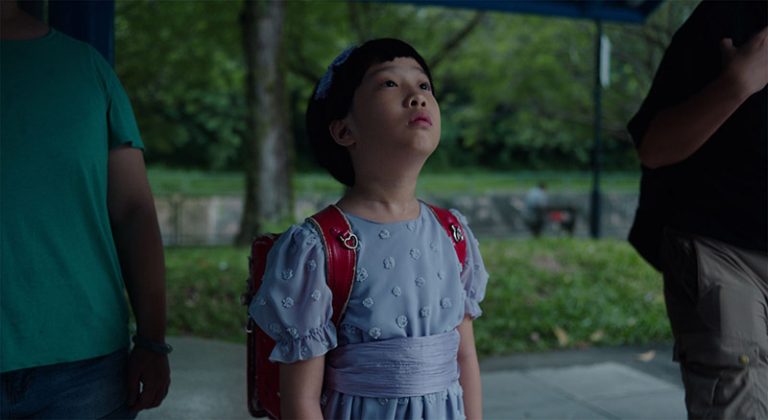
Finally, some films in this year’s ‘Reciprocal’ not only celebrate the formal freedoms and deeply personal motivations that underpin independent cinema, they also acknowledge its inherent precarity. Kaori Oda’s latest documentary short Recording with Mother: ‘Working Hands’ (2025), screened ahead of Underground, and Daniel Hui’s semi-fictional debut feature Eclipses (2011) both include family members who gently question the purpose of making these kinds of films. In Recording with Mother, Oda asks her mother to recount her working life in reverse chronological order while observing her present daily routine at home. As she prepares food, her mother remarks, ‘Not many people like this kind of movie.’ From behind the camera, Oda simply replies, ‘There’s a few’—an understated acknowledgement that independent films often find only modest audiences. A similar sentiment can also be found in Hui’s Eclipses, screening here for the first time since its premiere 15 years ago. Blending fictional and documentary elements, the film begins with a young woman mourning the loss of her husband before being ‘eclipsed’ as the narrative expands outwards to include the lives of those around her, including family members, co-workers and others trying to get by in Singapore. Several of these figures are played by Hui’s own relatives, most notably his grandfather, who initially proves reluctant to participate. Not long after Hui’s grandfather finally begins to speak, the camera runs out of film, leaving the soundtrack to continue over an extended stretch of black while the reels are changed. Reflecting on his grandson’s decision to become a filmmaker, he remarks: ‘Everyone wants to work after their studies. But after he [Hui] finished his studies, he decided to make movies instead. Movies won’t earn him any money.’ However, he then smiles, adding: ‘I hope he gets what he wants. I hope he fulfils his dreams.’ Rather than cutting these moments of uncertainty, both filmmakers leave them within their finished works. In doing so, fleeting conversations between filmmakers and their families become reflections on independent cinema itself—its audiences, its purposes, and the often precarious commitment required to pursue it.
 Image still from Eclipses (2011, Daniel Hui)
This brings us back to the question posed by the performer Arjun Raina in Avikunthak’s Dancing Othello: ‘What is the social message of this film?’ and, by extension, ‘What is the purpose of this film?’ ‘Reciprocal 2026’ resists any singular answer. Instead, it presents independent cinema as a plurality of practices and purposes that ebb and flow across time and geography: a space for formal experimentation, for preserving fragile memories, for documenting overlooked ways of life, for transmitting knowledge between generations, and for sustaining personal forms of creative expression that might otherwise struggle to exist. Perhaps the answer to Raina’s question is not a single social message at all, but the fact that independent cinema not only continues to be made—it must.
About the Writer
 Mark Player is an independent scholar who specialises in East Asian cinema, with a focus on Japanese amateur, underground and independent film cultures. He is the author of Japanese Cinema and Punk: Intermedial Exchanges (Bloomsbury Academic, 2025), as well as numerous academic articles and book chapters on Japanese film and other media. He previously taught film at the University of Reading, UK, on world cinema, film festivals and film practice.


