
Miuccia Prada declared once, “Study, study, study! Learn, watch movies, watch art, read literature”. Over a livestream in 2020, as advice on how to become a fashion designer. Film is no doubt an effective medium to get acquainted with style and how the body reacts to good design. Having run MFYG (Magazine for Young Girls) since 2020, it was exciting to have a memory institution like the Asian Film Archive (AFA) be interested in exploring the world of fashion and the culture that surrounds it. I was thrilled to be able to work with the AFA team, to watch the films and come up with an installation and pop-up market with the involvement of other fashion collectives.
To complement AFA’s screening programme, MFYG wanted to create an event that would help promote these films to a teenage fashion conscious crowd in a more embodied way than simply consuming products. A common theme amongst the featured films, from fiction to documentary, was that the presentation of oneself through clothing can shape a person’s experience in life. Tony Takitani (2004) is about a man whose wife is a shopping addict; Happy Berry (2004) follows a group of youths in Bangkok who run a fashion brand together; documentaries on designers such as Notebook on Cities and Clothes (1989) is on Yohji Yamamoto who insists he is more tailor than designer while Mao’s New Suit (1997) traces the ascent of Guo Pei, the designer behind Rihanna’s 2015 Met Gala ensemble that was exhibited at China: Through the Looking Glass, the Metropolitan Museum of Art’s exhibition on the impact of Chinese design on Western fashion. Each story is so drastically different yet the passion, dedication and devotion of the characters stood out to me.
 Obsessions – an installation creative directed by Magazine for Young Girls for AFA’s Styled & Sutured: Fashion on Screen programme
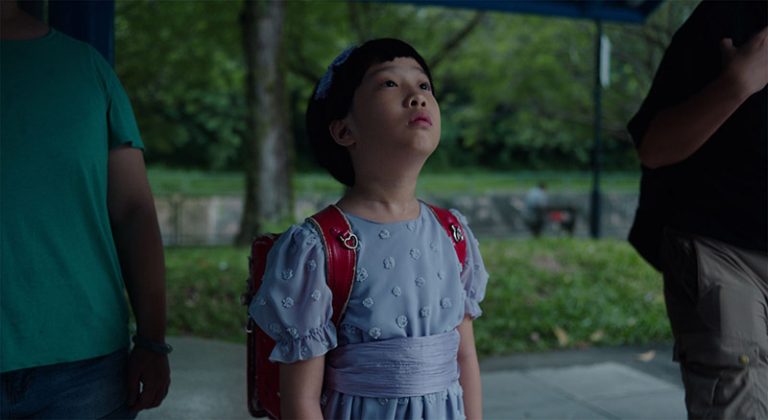
 Image still from Happy Berry (2004, Thunska Pansittivorakul)
Hence, I wanted to find collaborators that could bring that same passionate energy to whatever we produced for the programme. MFYG teamed up with spatial designer Amirul Nazree to design an installation at the Oldham Theatre atrium. He too, has a history of being a fashion obsessive and even had a Helmut Lang inspired label in his younger years. I thought of Gynne, the living embodiment of Harajuku style with her partially bleached dyed hair and kitschy-cute dressing, a style icon in her early 20s. She runs the online store and Instagram page, Dirt Fruits which has inspired legions of fans in Singapore and beyond to enjoy Harajuku fashion for fairly affordable prices. Next, I approached Upstairs Garments, a newly opened second hand designer vintage store in Tanjong Pagar. Upon reaching out, I got acquainted with the quartet of friends Adrienne, Ker Hsien, Xavier, and Vegas. Decked in swishy vintage Yohji Yamamoto jackets, pageboy caps and balloon trousers, each person had their own distinct style and personality. Something about their camaraderie, teamwork and enthusiasm reminded me of the rowdy crew in the anime, One Piece.
A key inspiration for the installation is the photography book depicting fashion obsessed individuals in their bedrooms titled Happy Victims which can be found in the installation itself. In the book, self-confessed fashion “victims” live in modest households in order to afford expensive clothes. The pictures framed these individuals with their clothes spread around the house, forming an indelible visual style that explores the lengths people go to for fashion. Given the massive collection of niche clothing from my collaborators, I wanted to reconstruct their bedrooms as a way to bring these personal collections closer to the public.
Guided by the personal interests of Dirt Fruits and Upstairs Garments, the installation became a time capsule of fashion cultures occurring in the early 1990s to the late 2000s. They are just two examples of many fashion obsessives around the world who dedicate their time to finding rare fashion items that speak to their identity. You can see from the magazines, books and decorative objects in their collections, that style extends way past just clothing. It becomes a lifestyle and an awareness for other disciplines like graphic design, the decorative arts, architecture, music and of course film. There is so much in the world of aesthetics that one can find a home in.
 (L-R): Image still from Notebook on Cities and Clothes (1989, Wim Wenders), two photographs from Kyoichi Tsuzuki’s ‘Happy Victims’ series from 2008, image still from Tony Takitani (2004, Jun Ichikawa)
In AFA’s Styled and Sutured film programme, fashion is depicted to have an indelible influence in one’s life. In Happy Berry (2004), fashion becomes a major motif in the lives of the protagonists. Similarly, Dirt Fruits and Upstairs Garments accrue experiences that are transformative in their personal lives. Gynne has turned her interest into a functional business, garnering an online cult following that connects her to fellow “obsessives” around the world. For Upstairs Garments, a deep friendship and business partnership developed from their love for collecting esoteric Japanese fashion labels, labels from the famed Antwerp 6 and Rick Owens.
Aesthetically sumptuous films like Tony Takatani (2004) and The Fall (2006) can spark an emotional connection by way of storytelling and stylish spectacle. Through the consumption of film, magazines, books and online resources, these collectors accrue knowledge around a specific aesthetic. Fashion is a key component and the inspiration behind these garments and information about the designers themselves become a rabbit hole of information. The desire for acquiring clothing and paraphernalia in the flesh is a natural next step.
It is notable that the individuals behind Dirt Fruits and Upstairs Garments are in their early 20s and have not experienced the time period in which they collect clothing from. Yet by collecting, talking about and wearing these garments, they inevitably bring back past trends and preferences, sparking a new wave of interest.
 Magazine for Young Girls (MFYG) getting stocked at Basheer Books
I myself have been a collector of fashion magazines since a young age. Whenever life felt dull and uneventful, a trip to Kinokuniya for Japanese titles or Thambi’s Magazine Store was the antidote. Teen Vogue was the magazine I bought religiously. To keep up with the latest editorials I browsed fashionspot.com, and Livejournal for updates of my favorite models. Tumblr was a go to for never ending mood boards consisting of magazine scans and music recommendations. Pinterest was for everything else. Today Instagram, Tiktok, Xiao Hong Shu and Youtube provide firsthand information and the flow is frictionless. Magazines have become symbolic, like a talisman for fashion devotees to signal that they are keeping the faith.
Ironically,engaging with these young collectors gives me a sense of hope that print and physical items will be cherished in the future. The interaction is different but the demand for it is still there!
On 15 and 16 February, there will be a market pop-up held at the Oldham Theatre atrium where more fashion obsessives are invited to sell their wares. The lineup includes Malaysian fashion brand Shaofen, jewellery makers ItsMakeMake and Socks in My Mouth, Sean’s bookshop that sells rare fashion and art books, and some friends of ours who we know are fashion obsessives. Of course, copies of our magazine will also be on sale!
Best,
MFYG x
This piece was written by Wong Wei Ting, founder and editor-in-chief of Magazine for Young Girls (MFYG). MFYG was in charge of the Obsessions installation and pop up market as part of AFA’s Styled & Sutured: Fashion on Screen programme. The Obsessions installation will be on display at Oldham Theatre until 23 February 2025. The screenings for Styled & Sutured: Fashion on screen will run until 23 February 2025.


