
March 2025
This issue of the Asian Cinema Digest highlights women-centric works in honour of International Women’s Month, ranging from experimental performance videos to Japanese New Wave finds and flirty Bollywood flicks.

In celebration of International Women’s Month, AFA invites you to Look/See: The Female Gaze in Cinema. This programme consists of 13 film screenings, Q&A segments with filmmakers, and a maker’s market on 22-23 March 2025.
Look/See runs till 30 March 2025 and explores how the gaze is challenged, reclaimed, and subverted by female protagonists and filmmakers. Make sure to catch the 50th anniversary screenings of restored classics, Picnic at Hanging Rock (1975) and Chantal Akerman’s Jeanne Dielman, 23 Quai du Commerce (1975), stirring dramas Missing Johnny (2018) and Saint Omer (2022), and exclusive director Q&A sessions at Archaeology of Love (2022) and Kimi Takesue’s 3-film special feature The Cross-Cultural Gaze.
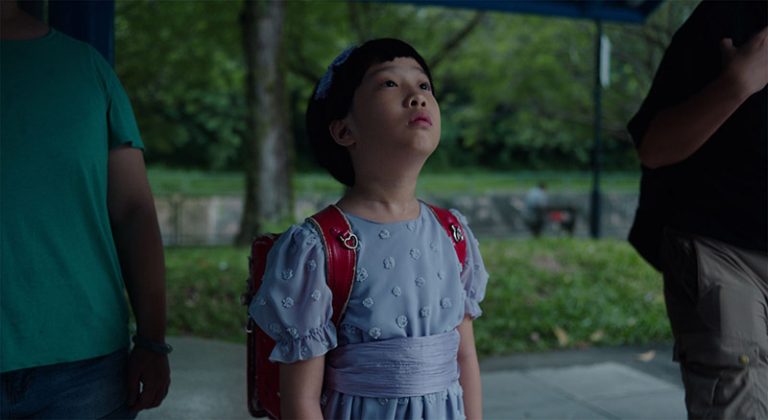
 Image still from The Young Ones: Ullarivu (2023, Sumi Mathai)
Nowness Asia presents Ullarivu (2023), Sumi Mathai’s contemplation on girlhood and loss of innocence. Set in a semi-rural household in Kerala, this Malayalam-language short follows a young girl on the cusp of adolescence as she navigates her relationship with nature, the complex family dynamics within a patriarchal household, and a troubling encounter with the outside world. Mathai sensitively captures the natural and social world through the young protagonist’s eyes, delivering a nuanced portrayal on the universal coming-of-age experience.
 Image still from Demon Pond (1979, Masahiro Shinoda)
Criterion Channel: Demon Pond (1979)
Catch Japanese New Wave director Masahiro Shinoda’s stylish adaptation of a classic Kabuki tale into a dimension-shattering folk horror fantasia. Set to the swirling strains of electronic-music pioneer Isao Tomita’s synth score, Demon Pond blends theatrical artifice with cinematic surrealism for an aquatic-apocalyptic fable of human love and folly caught in the current of nature’s wrath. Now streaming on Criterion Channel.
 Image still from Poetry (2010, Lee Chang Dong)
Criterion Channel: Directed by Lee Chang Dong
If you missed AFA’s Lee Chang Dong retrospective at Oldham Theatre in May 2024, here’s your chance to catch up on the 6 feature films directed by the South Korean filmmaker and literati. Green Fish (1997), Peppermint Candy (1999), Oasis (2002), Secret Sunshine (2007), Poetry (2010), and Burning (2018) are available to stream now on Criterion Channel.
 Image still from In Love (2001, Patty Chang)
e-flux’s Staff Picks series showcases two experimental performance videos by Los Angeles based artist Patty Chang, which are available to stream on their website in March. Chang’s provocative and darkly humorous films Melons (At a Loss) (1998) and In Love (2001) employ the body as a site of confrontation for femininity and socially constructed notions of desire. Her use of visceral and subversive imagery in these works addresses and challenges the notions of consumption and desire which are projected onto the female body.
 Image still from Eat Drink Man Woman (1994, Ang Lee)
Asia Society: Eat Drink Man Woman: Film Discussion with Tim Squyres
As part of Asia Society New York’s retrospective “Water and Oil: The Movies of Ang Lee” which ran from 14-23 February 2025, film editor Tim Squyres talks about Ang Lee’s movie Eat Drink Man Woman (1994), a family-centered drama exploring the complex relationships between a widowed chef and his daughters.
31 years after its release, Squyres shares the process and creative decisions that went into the iconic opening sequence of the film. Squyres also reflects on his extended collaboration with Ang Lee, including the experience of editing in a language he doesn’t speak.
 Image still from The Dirty Picture (2011, Milan Luthria)
Pitu and Beth from Filmi Ladies dive into the colour purple in Hindi Cinema. Bringing in fun trivia about the colour in fashion and popular culture, they trace the shifting connotations of the colour throughout history. Beth’s chosen film, Badhaai Do (2022), features a lavender marriage between a closeted police officer and a physical education teacher in a sensitive big-screen portrayal of the gay and lesbian community, while Pitu talks about purple prose in the stylishly raunchy musical-drama The Dirty Picture (2011), loosely based on the life of Silk Smitha, an Indian actress noted for her erotic roles. They consider the role of vibrant hues in the women and queer characters’ reclaiming of their sexuality, and discuss other iconic purple outfits in Bollywood.
 Image still from The Seed of the Sacred Fig (2024, Mohammed Rasoulof)
Michelle Quay discusses The Seed of the Sacred Fig (2024), Mohammad Rasoulof’s gripping political drama which won the Special Jury Prize at the 77th Cannes Film Festival last year, and received an Academy Award nomination for Best International Feature. Its plot centers on an investigating judge at the Revolutionary Court in Tehran who grapples with paranoia as nationwide political protests due to the death of a young woman intensify.
Quay argues that Rasoulof’s feature film creates a compelling, complete, and accurate visual account of the Woman Life Freedom protests in Iran by employing documentary-style techniques and strategic leveraging of raw footage filmed on-the-ground. Incorporating powerful anecdotes and comprehensive knowledge of the history of protest movements in Iran and related media, Quay puts forth a compelling argument for the strengths of Rasoulof’s courageous statement against authoritarian suppression.

Metrograph: Interview with Sandhya Suri
Inney Prakash interviews filmmaker Sandhya Suri about her bold feature debut, Santosh (2024). The Hindi-language film centres on the titular character Santosh (Sunita Rajwar), a young widow financially compelled to take over her husband’s former job as a police officer who is tossed headfirst into a hellish pit of corrupt and misogynistic men as she investigates the chilling murder of a teenage girl.
Suri reflects on the process of transitioning from nonfiction to narrative film, delving into her creative process and influences behind the film, which took 10 years to research and write. Suri shares how she navigates depicting the heavier themes of casteism, misogyny, violence, and Islamophobia within the film.
Catch Santosh at AFA’s Look/See programme at Oldham Theatre on 29 March, 5pm. Tickets here.
 Image still from Bye Bye Love (1974, Fujisawa Isao)
Luke Goodsell delves into Bye Bye Love (1974), the Japanese New Wave road movie directed by Fujisawa Isao which was rediscovered in 2018. The film focuses on a doomed romantic couple as they steal, swindle, and murder their way up the east coast of Honshu towards their date with destiny in Aomori.
Goodsell describes it as an avant garde ballad of lovers-on-the-lam which is subversive and anarchic, questioning ideas of gender, identity, and even nature itself. He discusses the film’s stylistic choices and its use of the road movie trope as a playground for explicit explorations of sexuality, gender, and identity, drawing references to Kabuki Theatre, Ken Takakura, and Yoko Ono’s Fly (1970).
Singapore Shorts is an annual showcase organised by the Asian Film Archive that celebrates the boldness and diversity of Singapore short films. The programme will feature a broad range of new works chosen by an esteemed selection panel. There will be online discussions with the filmmakers, critical writings, as well as a special guest curated programme. Screenings will be held at the Oldham Theatre in August 2025. The rules and regulations can be found here, and the deadline for submissions is March 21, 2025.
Experimental Film and Video Festival in Seoul, a.k.a EXiS, was founded in 2004 by Moving Image Forum in order to screen experimental films and contemporary moving images that explore the unknown forms and territories of cinema. The rules and regulations can be found here, and the deadline for submissions is March 23, 2025.
Women photographers, filmmakers, and visual artists who use film or photography are invited to submit work for Objectifs’ 8th Women in Film & Photography Showcase in 2025. Selected work will be part of the print exhibition, slideshow/video installation, artist talks or screenings at Objectifs (Singapore) from October to November 2025. The showcase centres on the theme “What we carry” and focuses on work from Southeast Asia, East Asia and South Asia. The rules and regulations can be found here, and the deadline for submissions is 28 March 2025.
Founded in 1993, Shanghai International Film Festival (SIFF) focuses on awards, markets, forums and film exhibitions so as to build an international platform, and promote the development of the Chinese film industry. The film festival takes place in June 2025 and accepts feature films and short films completed after 1 April 2024. The rules and regulations can be found here, and the deadline for submissions is 31 March 2025.
The Association for Curators and Programmers of Asian Cinemas (ACPAC) is accepting abstracts and papers for its launch symposium, Rethinking Film Curation in Asian Cinemas. The event hopes to ignite discourse between film curators, scholars and industry professionals, and will be co-hosted by AFA in September 2025. The rules and regulations can be found here, and the deadline for submissions is 15 April 2025.
This edition of the Asian Cinema Digest was compiled by Kuo Yi Quan. The Asian Cinema Digest is a monthly compilation of content taking place internationally involving Asian cinema and the moving image. Featured programmes are not representative of AFA’s views and are unaffiliated to the AFA unless otherwise stated.


