
What is kin? The span of a life is marked by encounters, intimacies, possibilities, commitments — relationships as brief as a glance and as prolonged as the wait for a BTO. What kinds of connections qualify as kinships? Or: What do kin owe one another?
Films by Angeline Klarissa, Giselle Lin, Caleb Ong Cabusao, and Jessica Goh give me glimpses of possible answers. Their cinematic landscapes lead me through the dim hallways of childhood, the mirror houses of families chosen and unchosen, and the laughter of friendships that have carried me here.
1. We don’t choose, and we choose, our kin.
We were born corded, then severed from our mothers’ bodies. In lieu of these physical ties which kept us fed, we were given new, less tangible cords upon which our early needs depended.
These earliest relationships formed through an imbalance of autonomy. Dependent on our primary caregivers to survive, we studied how they responded to our needs until we felt assured of our safety, or until vigilance became second nature.
 Image still from I look into the mirror and repeat to myself (2023, Giselle Lin)
Giselle Lin’s I look into the mirror and repeat to myself (2023) is a quietly aching retrospective look at a childhood of the latter sort. The film is structured as a series of audio interviews between Lin and her four sisters, each section marked by their Chinese given names.
What’s particularly compelling is how their individual perspectives constellate into a sisterhood — a collectivity, an invisible and mutual knowing — built upon their shared trauma. Between the explosive, violent anger of a lonely father and a distant, unaffectionate mother, a complex kinship formed between sisters who were so coalesced they had to be physically separated from each other; sisters who hated one another; and sisters who united as an “us against them”.
Now more autonomous, the sisters who were previously stuck together have diverged. Some have moved out. Some have chosen not to be friends. “It was bound to happen,” one sister remarks. Their shared plight not only bound them to one another but also made inevitable their flight from family. Space is needed to hold the enormity of what one sometimes lives through.
Despite the ache, the soft visuals of the film give its difficult conversations a nostalgic finish, suggesting an acceptance of what’s come to pass. The expectations or prophecies of one’s name cannot determine one’s life path. A horrific experience may mark but also connect us. We choose how we narrate what we remember of before. We choose who we will next become. Kinship ultimately flourishes or wilts not because of what we cannot choose, but what we can.
2. Yet kinship can be lonely.
Lin’s film begins with her perspective, and after we traverse her intimate conversations with her sisters, we arrive back in her body, a melancholic interiority through which all the light passes. “ Is this my life?” she asks. “Do I hold out my hands to receive it?” I’m reminded of Li-Young Lee’s “Secret Life”, where the speaker, “a boy growing old at the dining room table”, studies diagrams of flowers, through his loneliness seeking in them “something to do with his own fate/ and the perfection of all dying things.” How lonely it is to seek yourself in absence.
 Image still from Dragonflies (2023, Angeline Klarissa)
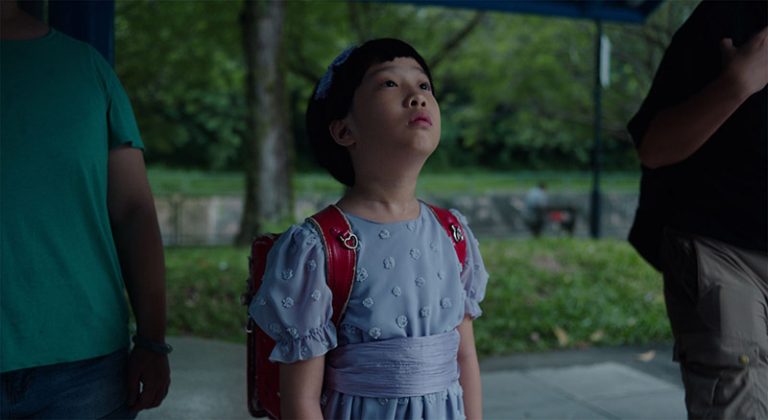
This loneliness is echoed in Angeline Klarissa’s Dragonflies (2023), where a mother-daughter relationship is brought to fore by daughter Yu Qi’s entanglements with her chosen family of gangsters.
Yu Qi’s relationship with her single mother is abrasive yet distant, and she spends her time working amidst a syndicate of “sisters” as hitmen-for-hire under Bing Jie, a seamstress. This is her family of choice — a family which, when she flees a run-in with the police, leaving another sister behind to take the hit, chooses to beat her up brutally as punishment. It’s unclear what’s really in it for Yu Qi, but perhaps her longing for love and belonging drives her to take what she can get.
Dialogues between mother and daughter vibrate with disappointment and yearning. And despite being chosen family, the syndicate offers Yu Qi a similar dismissive friction. Everyone is lonely in their relationships with one another, and Yu Qi’s attempt to secure some form of kinship seems to only cost her herself.
Ultimately, Yu Qi’s loneliness seems to be something she chooses — because she chooses her mother. After spending much of the film at odds with her mother, Yu Qi risks herself to protect her mother against one of her sisters. She chooses whatever blood brought her at birth.
From this rupture comes an opening. Yu Qi’s mother stares at the two women bloodied on the floor. She seems to finally see her daughter. The door to home is flung open and she helps Yu Qi in. She gets a first aid kit and tends to her daughter’s wounds. For a moment, tenderness and connection feel possible.
But a knock cuts the film to black. The time and space needed to build intimacy is interrupted once more by the outside world which knocks hard on the doors of a hard-knock life. This ending suggests:
3. Kinships are ecological — embedded in habitat.
 Image still from Dragonflies (2023, Angeline Klarissa)
Like the Lin sisters who were subject to the habitat of their home and the habits of their parents, Yu Qi and her mother are subject to the encroaching outer world of other relationships, dreams, and choices that they’ve made. The intimate silence between them proves to be a brief bubble they may have to make sacrifices in order to protect.
In this sense, all kinships have their own ecological logic, and are situated within broader interactions with their environment and other agents. Just as any individual is shaped in part by the conditions they live in, our kinships are shaped by a wider world which could be benign, friendly, and/or hostile. That third space between us is not always easy to secure.
4. Nonetheless, kinship can be a light and playful room — a resilient space which holds both the trials and fantasies of selfhood, as well as the storms of life.
 Image still from The Pirate Club (2024, Caleb Ong Cabusao)
Caleb Ong Cabusao’s The Pirate Club (2024) depicts three boys — Green, Benji, and Ralph — in a madcap loser comedy that unfolds in the 24 hours before their National Service (NS) stints begin. Anxious to prove their manhood before that deadline, they undergo a series of goofball tasks such as saving a damsel in distress, drinking a messed up concoction that makes them throw up, and helping someone in need.
While their silly failures and feeble attempts at machismo are amusing, it’s clear from solo scenes with Benji that the humour is a mask for the deep sense of unease he feels about NS. “We’re supposed to be men,” one of the boys laments. They want to exceed the truth of who they are — earnest boys still figuring life out. They’re not men, and honestly, that’s okay.
The frustration briefly subsides when the trio relax and simply lean into enjoying their time together. Their friendship is where they each get to be whoever they are, with room to try new things and tell their own story. I’m reminded that sometimes, when the future makes us anxious, these close relationships are where we can seek refuge and escape. While I’m with my friends, life can just be fun and games — at least for a while.
Similarly, Jessica Goh’s Devotions (2023) demonstrates the gentle power of kinship as a pregnant mother and her two young children face a typhoon which appears at once literal and imagined. As water levels in the house climb, the children morph to navigate the water and break the spell.
 Image still from Devotions (2023, Jessica Goh)
At once abstract and concrete, specific and open, Goh’s style lends the whole film a dreamscape quality. Kinship is cast as an unspoken form of care with which challenges are more opportunities for imagination than real threats. Despite the force of nature coming upon them, there is never a moment of real panic in the film — rather, we swim within a bubble of imagination that borders on fantasy. The brief bubble at the end of Klarissa’s film, here we are submerged within a languid safety from start to end.
5. In the end, it seems that what we owe each other as kin is the willingness to bear loving witness.
Lin looks at herself. She looks at her sisters. Her sisters look back. They’re all Lin. They’re not Lin. Yu Qi glances at her mother, longing. Her mother’s eyes fall on her daughter’s bruised face. Green, Benji, and Ralph watch one another face their trials of manhood. The daughter in Devotions, who has turned into a frog, swims up to her mother’s face to kiss it.
Mary Oliver wrote, “Attention is the beginning of devotion.” At the heart of it, kin are people who are willing to really see me, with love, even if they don’t fully understand me. Kin supports me in my personal life quests. Kin chooses me even when our relationship is difficult and we don’t know how to talk to each other. Kin is a space of mutual safety.
 Image still from I look into the mirror and repeat to myself (2023, Giselle Lin)
6. And kin is necessarily partial, as in not total, whole, and complete —
Because none of us is that static, fixed, and permanently resolved. We are constantly changing and bringing our morphing facets to our relationships. We are constantly learning how to love each other well as this happens, as the ways we want or need to be loved also change. We are, as Donna Harraway evokes in A Cyborg Manifesto, “partial, contradictory, permanently unclosed constructions of personal and collective selves”.
This is true especially of The Pirate Club and I look into the mirror and repeat to myself, where kinship allows the protagonists room to see themselves reflected back, and to continue on their individual journeys of self-discovery. The self is not concluded by the other person, but rather helped along and seen in facets and fragments.
Kinship thus unfolds as a mutual sensing and willingness (to encounter, experience, and accept) one another, who are each on individual journeys as well. Like so many of life’s best gifts and mysteries, it is profound and yet simple. It is collaborative and also a path one must sometimes navigate alone.
7. It may be obvious by this point but: kinship is vital and necessary.
 Image still from Devotions (2023, Jessica Goh)
Being comfortable with solitude is important, but very few flourish without the life-giving attention, motivation, and support that comes from close relationships. Kinship is, fundamentally, a matter of survival — both physically as well as in spirit. Medical outcomes have been proven to improve when people feel loved. And for all the social wounds one may sustain in a life, it is also in community that much healing becomes possible.
What these four films demonstrate are four possible ways kinship may unfold. Though not always joyful, these depictions of kin nonetheless reveal how central these close, intimate connections are to our identities and life experiences. Even when they push us to breaking point, a part of us continues to choose the people we love. This can be true even if, like some of the Lin sisters, we also choose to walk away.
So does kinship abandon or home us? Does it determine our narrative or give us the means to write our own? As far as I can see, always both.But when kinship has room for us, does it not free us to become our own persons? Is it not a kind of channel through which the worst storms may pass without fear?
*
In short, kinship is another kind of love. It can co-exist with feelings and sensations like hatred, longing, frustration, combativeness, irritation, joy, ease, tension.
It says:
I see you and want to continue seeing you. I am willing to see you even in your silliest life projects, even if I don’t fully understand or may even struggle to accept what you’ve chosen.
You are someone I want to grow with, someone I want to cherish and be cherished by. I am willing to traverse the closeness, the uncertainty, the sheer joy, and even the loneliness that our kinship will entail.
I will grow as an individual, and so will you. When change happens, we will learn again how to be together. Even if we have to part, take space, or become distant, a part of me continues to choose you.
About the Writer
 Ang Kia Yee is a Singaporean writer and artist who works with text and performance to propose and enact alternative presents and futures. Playing across disciplines, forms, and media, her projects are anchored in the logic of poetry — what Carl Phillips describes as patterned language and the meaningful interruption of those patterns. Her work has spanned poetry, essays, short stories, plays, performances, audio walks, workshops, and video. She was a participating artist for Natasha, Singapore Biennale 2022; a selected participant for da:ns LAB 2023: IDIOSYNCRASIES at Esplanade – Theatres on the Bay; and a resident writer for Centre 42’s New Scripts Residency 2021.
The opinions expressed in this article are the author’s own and do not reflect the view of the Asian Film Archive.


