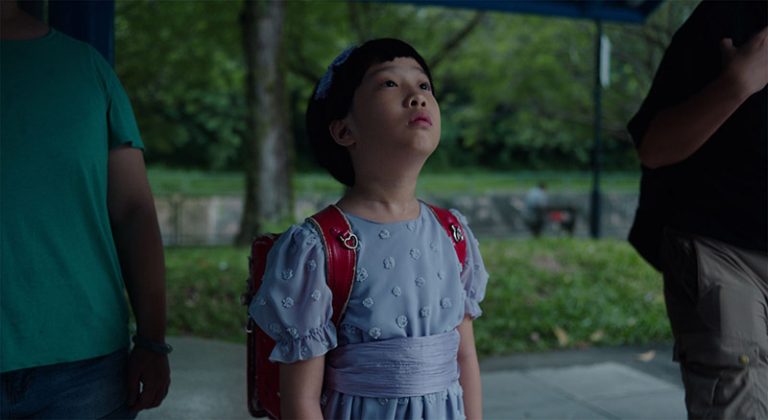

In collaboration with the Japan Foundation and Singapore Film Society, as part of the Japanese Film Festival 2026, the Asian Film Archive presents Twin Tales: Kon Ichikawa and Yasuzō Masumura, featuring three film pairings from these acclaimed directors.
Yasuzō Masumura (1924–1986) has been described by filmmaker and critic Shinji Aoyama as “the most important filmmaker in the history of postwar Japanese cinema.” Despite his prolific output and fiercely independent approach to filmmaking, Masumura remains an underrated figure in postwar Japanese cinema. His oeuvre of over 60 films spans a remarkably wide range of genres, from coming-of-age films, women-led films, social satires and corporate comedies to thrillers, noirs, melodramas, yakuza films and erotic cinema.
 Image still from The Burmese Harp (1956, Kon Ichikawa)
In the United States, Masumura became particularly known for the erotic films he made in the 1960s and 1970s, including Irezumi (1966), Blind Beast (1969) and Manji / All Mixed Up (1969). Yet a single defining style or genre is difficult to identify in his diverse body of work. Japanese critic Shigehiko Hasumi observed, “with Masumura, there’s no representative film.” Instead, his bold visual style and unconventional portrayals of desire, individualism and social conformity constitute a distinctive body of work that continually resists easy categorisation.
Kon Ichikawa (1915-2008), was hailed as “the last living link between the golden age of Japanese cinema, the spunky New Wave that followed and contemporary Japanese film.” Ichikawa’s daring style and bold exploration of different subjects, from the anti-war masterpieces The Burmese Harp and Fires on the Plain (1959) to the documentary Tokyo Olympiad (1965), which garnered two BAFTA awards, have been regarded as precursors of the Japanese New Wave.
A recurring theme in Ichikawa’s films was his concern over Japan’s postwar history. As Yukio Mishima puts it: “… behind the making of Mr Ichikawa’s exquisitely lucid films, one catches a glimpse of the struggle it took to shape the unique reality he has created, a place filled with the contradictions of present-day Japanese cinema” (*See Kon Ichikawa, written by Yukio Mishima). Ichikawa’s films examining Japan’s development also revealed what has been described as the “impotence and hypocrisy of the more or less liberal pre-war middle class, whose passivity aided the triumph of militarism.”
The first idea behind this Twin Tales programme is to explore how the Japanese studio system shaped the next generation of filmmakers. The programme does not trace a straightforward genealogy between filmmakers. Instead, it is more a process of mapping: exploring how the system of tutelage worked, how ideas and practices were passed between generations, and how different filmmakers approached the adaptation of works by the same writer. Through these connections and divergences, we have delineated not a single lineage of influence, but the different ways in which the filmmakers responded to, inherited, and departed from the cinematic traditions that came before them.
Masumura began his career as an assistant director at the Daiei studio in Tokyo. While at the Centro Sperimentale di Cinematografia in Rome, he studied under Michelangelo Antonioni, Federico Fellini and Luchino Visconti. After he returned to Japan, he worked as an assistant to Mizoguchi on the Shaw Brothers collaboration Princess Yang Kwei Fei (1955), as well as his last film, The Street of Shame (1956). After Mizoguchi’s death, he became an assistant to Kon Ichikawa. They collaborated on three films: Punishment Room (1956), Bridge of Japan (1956) and A Full-Up Train (1957), before Masumura made his feature debut, Kisses (1957).
Ichikawa’s A Full-Up Train follows Tamio Moroi, a fresh graduate who works as a white-collar employee at a brewery in Osaka. He is taught to do nothing except to pretend to be busy. When his mother goes insane and he has to send money for medical treatment, he is caught in a series of mishaps that turn his hair white, kill his friend, and leave him at the margins of the booming economy. A Full-Up Train’s comical depiction of the rapidly changing rhythms of postwar life offers a clinical critique of the relentless march of industrialisation. A semblance of the depiction of the dehumanisation of postwar Japanese society is evident in both Masumura and Ichikawa’s films. Nevertheless, Masumura’s energetic reiteration of these concerns distinguishes him from Ichikawa’s classicist approach.
In an essay, Masumura expressed his disappointment with A Full-Up Train, blaming its failure on the abstractness of the original script and Ichikawa’s exaggerated portrayal of everyday realism, which resulted in ‘uninteresting’ images. “Though Ichikawa was adamant about avoiding everyday realism, the film ended up merely clownish, moving frantically without breaking free of its realist frame,” (*see Kon Ichikawa’s Method) Masumura commented. Nevertheless, Masumura expressed his admiration for Ichikawa’s immense compositional talent and his pictorial approach to filmmaking. His dissatisfaction was not personal, but rather a criticism of the traditions and conventions of Japanese cinema.
In an interview by Jonathan Rosenbaum with Japanese critic Tadao Satō, Satō points out that Masumura was among the first of his generation to view masters such as Mizoguchi, Kurosawa and Ozu with a certain irreverence. Masumura is “[a] radical whose strategy was strictly to bore from within, working with whatever came to hand (including existing genres as well as scripts and actors); he can’t generally be identified with a specific visual style […]” Masumura’s criticism and Satō’s comment on Masumura point to a visceral yet vivid style that is not content to remain within established forms and genres.
Kisses, like A Full-Up Train, was released in 1957. It establishes its position as a forerunner of the forthcoming Japanese New Wave. The film follows Kinichi, a delivery boy, and Akiko, an artist’s model, who meet while visiting their fathers in prison. After successfully gambling on a bicycle race, they spend a pleasant day together at the beach, allowing a tender romance to bloom amid a Japan undergoing reconstruction, whose future, much like the protagonists’ fates, was uncertain.
 Image still from Kisses (1957, Yasuzo Masumura)
Ōshima Nagisa commented: “Yasuzō Masumura’s Kisses used a freely revolving camera to film the young lovers riding around on a motorcycle. I feel that the tide of the new age could no longer be ignored by anyone, and that a powerful, irresistible force had arrived in Japanese cinema.” Two things are worth noting: Ōshima’s observation on the liberation of the camera foregrounds the emergence of the Japanese New Wave; it also reveals how Masumura’s Kisses marked a break from the classical cinematic tradition that he had inherited from his predecessors such as Mizoguchi and Ichikawa. The film’s mobility, youthful energy and rejection of the static compositions associated with classical Japanese cinema suggest a filmmaker searching for a new cinematic language from within the studio system that shaped him.
Masumura once remarked in an interview: “Men are beings completely deprived of freedom. It’s probably because they don’t give birth. Men have to think of Honour, of Truth. But ultimately, men are animals that only live for women.” While men are chained to social expectations, women seem to provide another possible way of understanding the power dynamics and tensions between men and women, between the dominant and the submissive, the controlled and the controlling.
It is here that Jun’ichirō Tanizaki’s literary works become an especially fitting counterpart to Masumura’s cinema. Masumura himself once said: “You only need to read Tanizaki: all his heroes are weak, cowardly, ugly… A great virile man is not human, and that’s because he lives for others, for society.” Tanizaki’s literary works often revolve around the depiction of women, who are portrayed as powerful, manipulative and mesmerising femme fatales.
Masumura’s cinema is fascinated by women who refuse to remain passive objects of male desire, while Tanizaki repeatedly constructs worlds in which the very desire becomes inseparable from submission. Masumura’s adaptation of Manji remains faithful to the original novel: it is erotic, but places greater emphasis on the reversal of gender roles.
 Image still from Manji (1964, Yasuzo Masumura)
Mitsuko (Ayako Wakao) becomes the alluring figure around whom all the characters’ lives revolve. The love she gives to Sonoko (Kyōko Kishida) and Kotaro (Eiji Funakoshi) becomes a controlling tool. However, the female-centric relationship and the powerless male characters reverse the male gaze to a certain extent. The women in Tanizaki’s novel and Masumura’s film share a common defiance of the social expectations imposed upon women, particularly the ideal of the “good wife, wise mother” (ryōsai kenbo).
If sex serves as a recurring theme in Tanizaki’s novels, Kon Ichikawa takes a different approach to adapting Tanizaki’s works. In an interview, Ichikawa expressed that the excessive sexuality in Kagi (also known as Odd Obsessions) functions as a tool for critiquing Japanese culture and civilisation, which is deeply rooted in the conflict between the soul or heart and desire.
He further noted: “It is a story of human vanity and nothingness. It describes the humanness of the character through the vantage of sex. I should say that the sex is deformed to impart the struggle of human beings. Sex connects to one’s search for humanity, one’s true thoughts and position in society.” Readers familiar with Tanizaki might feel that the de-sexualisation of Kagi does not do justice to the novel, that it was a safer approach to adapting such a controversial novel in the 1950s, years before the boom of pinku films. One could say that Ichikawa’s adaptation is more restrained yet still erotic; his approach is more sensual than explicitly sexual.
Ichikawa wrote about his strategy for adapting the novel. He restructured the entire novel and developed the motifs of “repressed passivity” and the “comedy of murder.” He acknowledged that Tanizaki’s highly explicit writing serves the purpose of revealing the characters’ motives, but makes clear: “Yet it also goes without saying that I respect the universal convention that one must be clothed when appearing in public.” (*See Between Literature and Cinema, written by Kon Ichikawa).
Masumura’s approach is more akin to examining, from the inside out, the repression faced by Japanese society, whereas Ichikawa adopts a strategy of looking from the outside in. He approaches Tanizaki’s distorted representations of sexual desire and human nature through the text itself, although he also acknowledged that he “was so wrapped up in the practical aspect of things [that] I wasn’t completely immersed in the novel’s eerie atmosphere.” (Between Literature and Cinema) Although their approaches to adaptation are markedly different, they open up different perspectives for audiences to consider the shared concern: the exploration of human nature and desire.
For audiences unfamiliar with either director’s work, this is a good place to start.
Masumura’s films did not travel much beyond Japan following their domestic releases. Cahiers du Cinéma’s 12-page coverage of Masumura’s works in 1970 might be the most extensive critical recognition he received in the West, while critic Jonathan Rosenbaum wrote a detailed and insightful essay on Masumura in the 1990s. Due to the lack of literature on Masumura translated into English, his works have remained relatively overlooked outside Japan. While Kon Ichikawa was critically acclaimed on the international film circuit as early as the 1950s, his work has often been overshadowed by those of his peers, such as Ozu, Kurosawa and Mizoguchi. Hence, this section offers a brief introduction to some of the best works by both directors.
 Image still from The Blue Sky Maiden (1957, Yasuzo Masumura)
A Cheerful Girl (1957), also known as The Blue Sky Maiden, is regarded by renowned film critic Jessica Kiang as Masumura’s first masterpiece. A Cheerful Girl also marks the beginning of the collaboration between Masumura and Ayako Wakao. The film shifts from a Sirkian melodrama to a sprightly deconstruction of the social and familial structures of postwar Japan. It is an atypical coming-of-age film from Japan in the 1950s, as it subverts the “good wife, wise mother” narrative that dominated films released by Daiei Studios. When Yuko (Wakao) denounces her sick father as the source of the family’s problems, Masumura is not merely challenging the conventions of Japanese cinema, but also questioning the conservative and unyielding patriarchal society of postwar Japan.
On the other hand, Ichikawa’s The Burmese Harp (1956) navigates the clash between two different value systems in the aftermath of Japan’s defeat in World War II. The film probes the questions that emerged after the war: What was the reality of defeat for Japanese soldiers? How did they come to terms with it? Mizushima swings between two different value systems: one accepts defeat “as an inevitable consequence of the human condition” (see Character Type and Psychological Revelation in Ichikawa’s Biruma no tategoto, written by Keiko I. McDonald), while the other rejects defeat and reckons with the past glories of Imperial Japan. The film becomes a spiritual quest for Mizushima, who moves between these two value systems before reconciling them at the end of the film. Ichikawa’s humanist portrayal brings a thorny question that remained at the core of postwar Japanese society to the forefront: What did the war mean to Japan?
* The essays mentioned above are collected in Kon Ichikawa, an anthology edited by James Quandt, published by Cinematheque Ontario in 2001
Written by Lee Peng Ming and Edited by Alexander Lee
On Yasuzo Masumura:
On Kon Ichikawa:
On Tanizaki


